


Contenido
Every week I get asked the same question: «Why do offshore casinos offer so much bigger bonuses than regulated ones?» The answer isn’t generosity — it’s mathematics. The size of a bonus is inversely related to the probability that you’ll ever withdraw it. Offshore casinos can afford to offer eye-catching headline numbers precisely because their wagering requirements are designed to ensure most players never convert bonus funds into real money. Let me walk you through how this actually works, with numbers rather than marketing slogans.
The Mathematics of Wagering Requirements
I remember the first time I ran the expected-value calculation on a no-deposit bonus and felt genuinely annoyed at how misleading the marketing was. Take a hypothetical scenario: a 50-euro no-deposit bonus with a 50x wagering requirement. That means you need to wager 2,500 euros before the bonus converts to withdrawable cash. On a slot with 96% RTP — a generous assumption for offshore sites — you’ll lose 4% of every euro wagered on average. Four percent of 2,500 euros is 100 euros. The bonus was 50 euros. The expected mathematical outcome is a net loss of 50 euros before you’ve deposited a single cent of your own money.

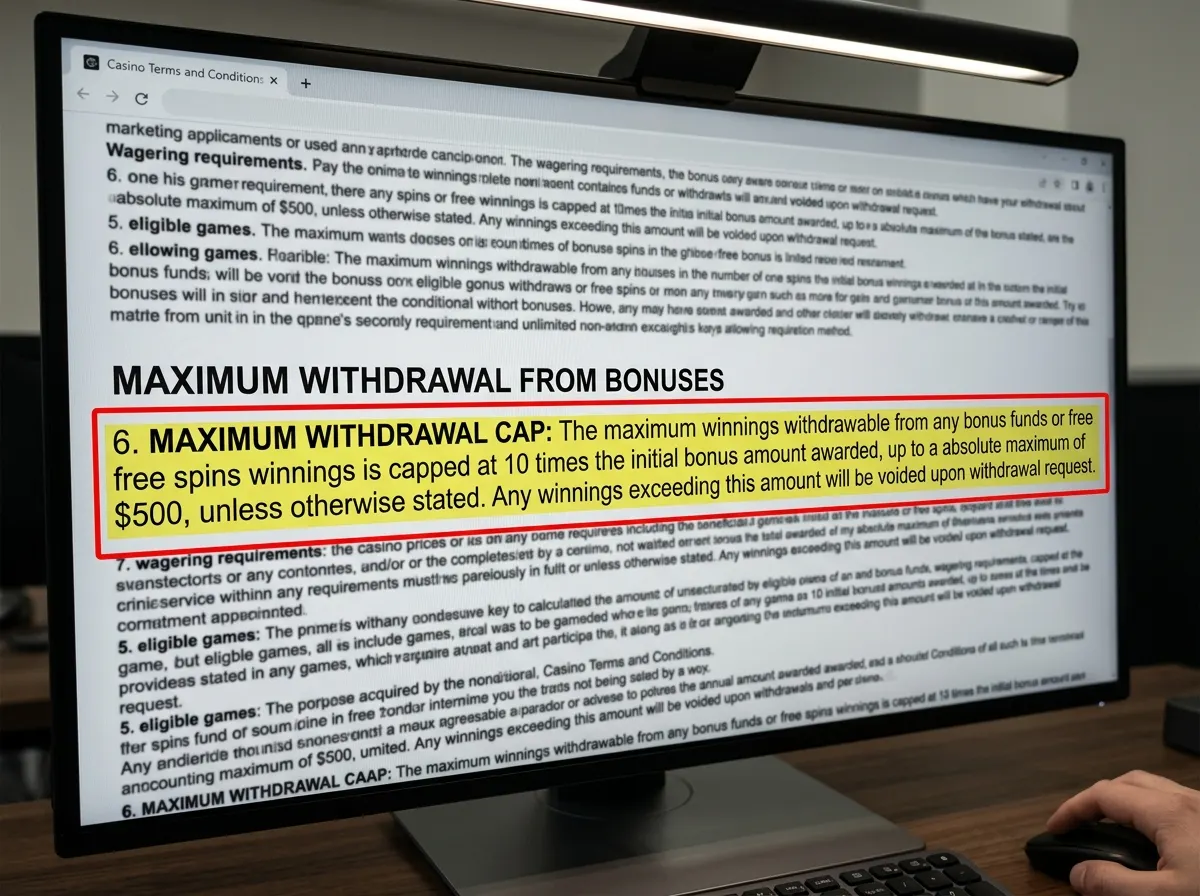
That’s the cleanest version of the calculation. In practice, it gets worse. Most no-deposit bonuses come with maximum withdrawal caps — often 50 to 100 euros regardless of how much you win. Game restrictions limit which slots count toward the wagering requirement, and live casino games typically contribute 0% to 10%. Time limits — usually 7 to 14 days — create pressure to wager faster, which increases variance and reduces the probability of meeting the requirement before the bonus expires.
Spain’s regulated market saw operators spend 664.40 million euros on marketing in 2025 — 39% of total GGR. Bonuses are a marketing cost, not a gift. At DGOJ-licensed casinos, regulatory caps limit both bonus sizes and wagering multipliers, which is why regulated bonuses look smaller. They’re designed to be achievable within regulatory guardrails. Offshore bonuses are designed to look impressive while being statistically improbable to convert.
Types of Bonuses at Offshore Casinos and What They Actually Cost
No-deposit bonuses are the entry point, but the offshore bonus ecosystem is broader and more layered than a single offer. Understanding the cost structure of each type prevents you from confusing marketing value with real value.

Welcome match bonuses — «deposit 100, play with 300» — are the most common. A 200% match sounds generous until you see the 40x to 60x wagering requirement applied to the deposit plus bonus total. On a 300-euro total, that’s 12,000 to 18,000 euros in required wagering. At 96% RTP, the expected loss during wagering is 480 to 720 euros — far more than the 200-euro bonus. The bonus has negative expected value for the player and positive expected value for the operator. That’s not a flaw in the system; it’s the system working as designed.
Reload bonuses target existing players with smaller matches — typically 50% to 100% — on subsequent deposits. The wagering requirements are usually similar to welcome bonuses, making the mathematics equally unfavourable. Cashback offers return a percentage of losses over a period, which is the most transparent bonus type because the value is straightforward: if you lose 1,000 euros and get 10% cashback, you receive 100 euros. Even cashback often comes with wagering requirements, though, so verify whether the returned funds are immediately withdrawable or subject to additional play-through conditions.

Free spins bonuses deserve special attention because the perceived value and the actual value diverge sharply. «200 free spins» sounds like a substantial offer, but the spin value is typically set at the minimum bet — 0.10 or 0.20 euros per spin. Two hundred spins at 0.10 euros each is 20 euros in total bet value. Apply the wagering requirement to any winnings from those spins, and the expected withdrawable amount shrinks to near zero. I’ve run simulations on free-spin bonuses at various RTP levels, and the probability of converting them into meaningful withdrawable funds is consistently below 5%.
Why DGOJ-Licensed Casinos Cap Bonuses and Offshore Ones Do Not
Spain’s DGOJ imposes restrictions on bonus structures precisely because unrestricted bonuses function as a player-acquisition tool that exploits psychological biases. Large headline numbers trigger the anchoring effect — players perceive the «free» money as a windfall rather than a marketing mechanism. The wagering requirement, buried in terms most people don’t read, is where the operator claws back the mathematical advantage.

Online casino generated 893 million euros in Spain’s regulated market in 2025, representing 52.51% of total GGR. The regulated market grows without relying on aggressive bonus structures because the DGOJ’s framework forces operators to compete on game quality, platform experience, and brand trust rather than on who can promise the biggest number in a banner ad. Offshore casinos face no such constraint, which is why bonus inflation is endemic in the unregulated sector.
The practical lesson is simple: evaluate any bonus or feature purchase by its expected value, not its face value. Run the wagering calculation before you assess whether the bonus is worth taking. If the expected loss during wagering exceeds the bonus amount — and it almost always does at high wagering multipliers — the bonus costs you money rather than saving it. The bigger the headline number, the more likely the mathematics are working against you.
FAQ
What is a realistic expected value of a 50-euro no-deposit bonus with 50x wagering?
On a slot with 96% RTP, you must wager 2,500 euros (50 x 50) to clear the bonus. The expected loss during that wagering is 4% of 2,500, which equals 100 euros. Since the bonus itself is only 50 euros, the expected outcome is a net loss of 50 euros. This calculation assumes consistent RTP without game restrictions or time limits, which would make the outcome even less favourable in practice.
Why do DGOJ-licensed casinos offer smaller bonuses than offshore ones?
DGOJ regulations cap bonus sizes and impose limits on wagering requirements to prevent operators from using mathematically exploitative bonus structures as a player-acquisition tool. Offshore casinos face no such restrictions, so they inflate headline bonus numbers while attaching higher wagering requirements that make the bonuses statistically harder to convert. The regulated bonuses are smaller in face value but more realistic in achievable value.