

Contenido
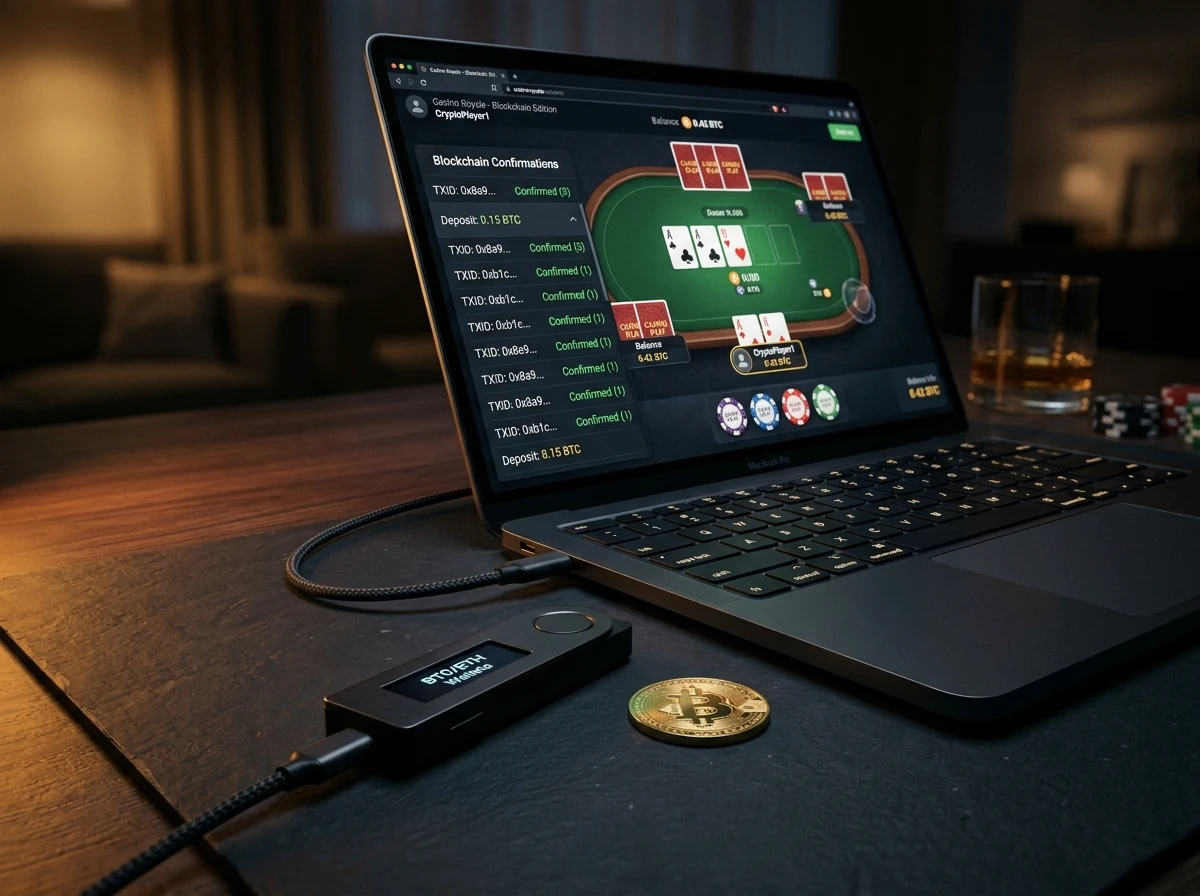
The first time I deposited Bitcoin at an offshore casino — purely for research purposes, which is a sentence every analyst in this space has said at least once — the entire process took eleven minutes. No identity verification, no document uploads, no waiting period. I sent BTC from my wallet to the operator’s address, received a confirmation within two blocks, and the balance appeared in my account. Compared to the multi-day KYC process at a DGOJ-licensed operator, it felt like stepping from a government office into a vending machine.
That speed and simplicity is exactly why crypto casinos have become the fastest-growing segment of the offshore iGaming market. The projected value of the global crypto gambling market exceeds 65 billion dollars in 2026, with a compound annual growth rate between 12% and 15%. Bitcoin dominates at roughly 66% of transaction volume, followed by Ethereum at 9% and Litecoin at 6%. For Spanish players, these platforms offer something the DGOJ-regulated market structurally cannot: anonymity, no deposit limits, no verification delays, and access to game categories banned or restricted under Spanish law.
But every advantage on that list is also a risk. No verification means no identity protection. No deposit limits means no spending controls. No regulatory oversight means no dispute resolution. In nine years of tracking this space, I have watched crypto casinos evolve from a niche curiosity into a significant market force — and the trade-offs have not changed, they have just gotten bigger. Here is how the mechanics actually work, what the tax implications are for Spanish players, and where the line sits between privacy and vulnerability.
The Billion Crypto Gambling Market in 2026
A colleague of mine — a payments consultant who had spent fifteen years in traditional banking — called me in late 2024 asking where all the transaction volume was going. His acquiring bank had noticed a measurable decline in card-based gambling deposits, but the operators they serviced were not reporting fewer players. The answer, of course, was crypto. Players were not leaving the market; they were leaving the payment rails.
The scale of this shift is hard to overstate. That 65-billion-dollar market figure is not a speculative projection from a crypto booster — it comes from aggregated transaction data across major blockchain networks. The compound annual growth rate sits between 12% and 15%, which means the market roughly doubles every five to six years. For context, the entire DGOJ-regulated Spanish online gambling market generated 1,700.55 million euros in gross gaming revenue during 2025, a figure that represents a strong 17% year-on-year increase. The global crypto gambling market is now roughly thirty-eight times larger than Spain’s entire regulated online sector.
Several structural factors drive this growth. First, cryptocurrency adoption has moved beyond the early-adopter phase into mainstream retail use, with major exchanges offering one-click purchasing in most European countries. Second, the infrastructure for crypto gambling has matured — operators no longer need to build payment systems from scratch. Third-party providers handle wallet integration, currency conversion, and blockchain monitoring as turnkey services. Third, regulatory tightening in licensed markets has created demand for alternatives. Spain’s advertising restrictions, deposit limits, and mandatory self-exclusion checks push some players toward platforms that do not impose these controls.
The geographic distribution of crypto gambling traffic tells its own story. Markets with strict online gambling regulations — Spain, France, Australia — show disproportionately high crypto casino usage relative to their populations. Markets with liberal regulatory frameworks — the UK, Malta, Denmark — show lower rates. The correlation is not coincidental. Mikel Arana, Director General of the DGOJ, acknowledged this dynamic directly: the regulator has data on credit card payments to all gambling operators and can check whether payments went to legal or illegal operators, and has initiated new strategies monitoring bitcoin gambling operations. The fact that Spain’s chief gambling regulator is actively tracking crypto flows tells you everything about how significant this channel has become.

How Crypto Casinos Process Deposits and Withdrawals
I remember explaining crypto casino mechanics to an editor once and watching his expression shift from confusion to disbelief — not because the technology was complex, but because the process stripped away every friction point he associated with online gambling. No bank involved, no payment processor, no credit check. Just a wallet address and a blockchain confirmation.
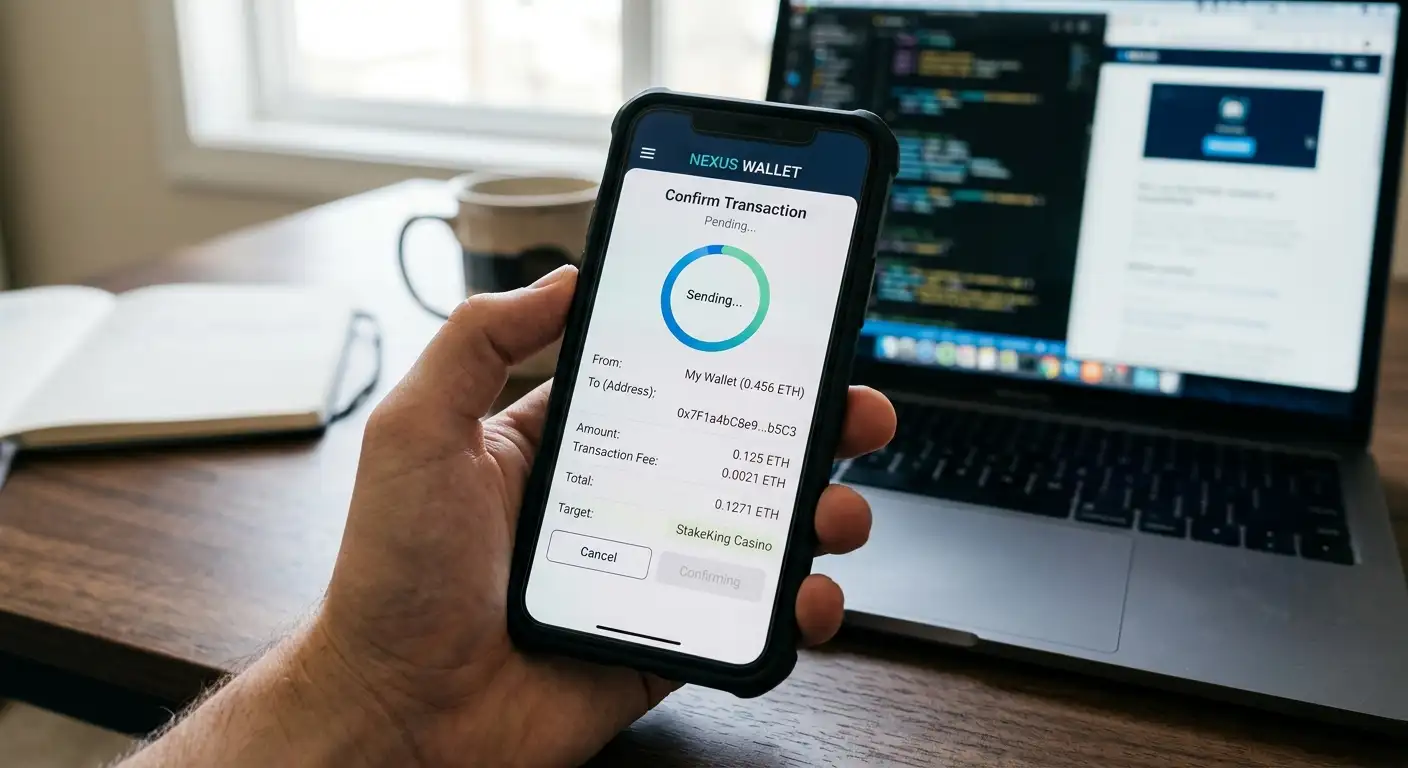
The deposit process works like this. You create an account at the crypto casino — often requiring nothing more than an email address or, at some platforms, not even that. The casino generates a unique wallet address for your account, typically for Bitcoin, Ethereum, or another supported token. You open your personal crypto wallet — whether that is a hardware device like a Ledger, a software wallet like MetaMask, or an exchange wallet on Binance or Coinbase — and send the desired amount to the casino’s address. The transaction goes to the blockchain for confirmation. Bitcoin typically requires two to three confirmations, which takes roughly twenty to thirty minutes depending on network congestion. Ethereum is faster, usually under five minutes. Once confirmed, the equivalent gambling credit appears in your casino balance.
Withdrawals follow the same logic in reverse, but with a critical difference: speed and reliability vary enormously between operators. At a well-run crypto casino, withdrawal requests are processed within hours — sometimes minutes. At less reputable operations, withdrawals can be delayed for days, subjected to sudden verification requirements that were not mentioned at deposit, or simply denied. In DGOJ-regulated casinos, withdrawal processing standards are enforced, and the UK Gambling Commission’s data shows that 96.3% of withdrawals at licensed operators are processed instantly. No equivalent standard exists for offshore crypto operators. Your recourse if a withdrawal is denied is functionally zero.
The conversion layer adds another dimension. Most players do not hold large crypto balances purely for gambling — they buy cryptocurrency specifically to deposit. This introduces exchange fees, typically between 0.5% and 1.5% on a retail purchase. Network transaction fees add another layer: Bitcoin fees fluctuate with demand, ranging from under a dollar to over twenty dollars during peak congestion periods. Ethereum gas fees are similarly variable. These costs are invisible in the casino’s interface but real in your wallet. A player depositing 200 euros worth of Bitcoin might lose 5 to 10 euros in exchange and network fees before placing a single wager — costs that simply do not exist when depositing via bank transfer at a regulated operator.
Some platforms have introduced intermediary solutions. Hybrid casinos accept both fiat currency and crypto, converting between them internally. Others use payment processors that handle the conversion at the point of deposit, so the player sends euros and the casino receives crypto (or vice versa). These hybrid models blur the line between traditional and crypto gambling, and they present interesting regulatory challenges — if a Spanish player deposits euros via a card but the operator processes the transaction through a crypto exchange in Seychelles, which jurisdiction’s rules apply?
Bitcoin, Ethereum, and USDT: Which Tokens Casinos Accept and Why
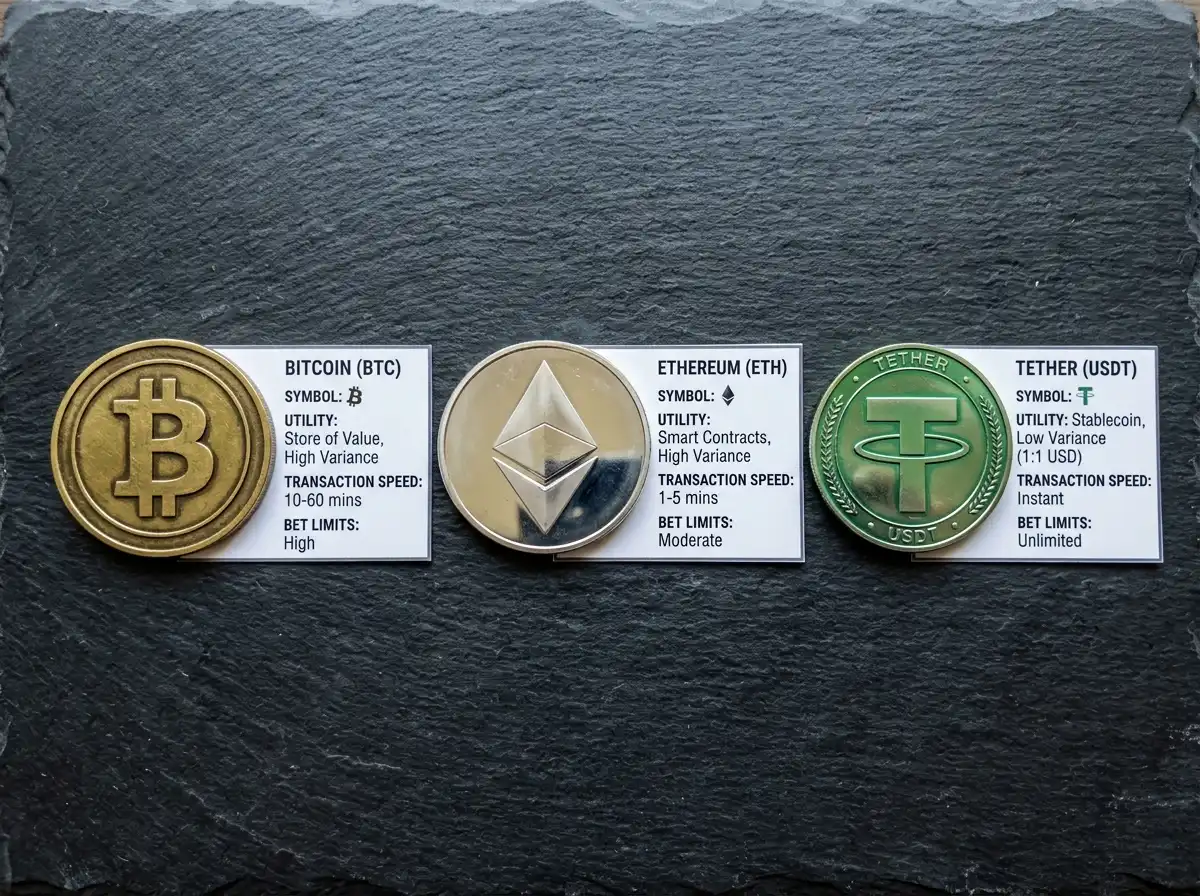
Not all cryptocurrencies are created equal when it comes to gambling, and the differences matter more than most players realise. I spent a month in early 2025 documenting the token acceptance policies across forty offshore casinos, and the pattern was consistent enough to map: Bitcoin at 66% of total transaction volume across the sector, Ethereum at 9%, Litecoin at 6%, and then a long tail of alternatives each holding single-digit shares. But market share does not tell you which token is best for which purpose.
Bitcoin remains dominant for a simple reason: liquidity. It is the easiest cryptocurrency to buy, the most widely held, and the most universally accepted. Every crypto casino accepts BTC. The drawbacks are real, though. Transaction confirmation times average twenty to thirty minutes, and network fees spike unpredictably. For a player making a single large deposit, this is manageable. For someone making frequent smaller deposits, the fees can consume a meaningful percentage of the gambling bankroll. Bitcoin’s price volatility adds another variable — your 500-euro deposit might be worth 480 or 520 euros by the time it clears, depending on what the market does during those confirmation minutes.
Ethereum occupies a different niche. Faster confirmations, typically under five minutes, and a more flexible infrastructure that supports smart contract-based gambling platforms. These are casinos where the game logic itself runs on the blockchain — provably fair in a verifiable, cryptographic sense rather than relying on a third-party audit of an RNG. The gas fee problem persists, though Ethereum’s transition to proof-of-stake and layer-2 scaling solutions have brought average transaction costs down substantially from the peak levels of 2021-2022.
The real shift in the crypto gambling space, though, is toward stablecoins — and USDT (Tether) in particular. Stablecoins are pegged to fiat currencies, usually the US dollar, which eliminates the volatility problem entirely. A player who deposits 500 USDT will have a balance equivalent to 500 dollars regardless of what Bitcoin or Ethereum do during the session. For operators, stablecoins simplify accounting and reduce the hedging costs associated with holding volatile assets on their balance sheets. Acceptance of USDT has grown rapidly: among the forty casinos I surveyed, thirty-one accepted USDT in 2025, up from nineteen the previous year.
Lesser-known tokens like Litecoin, Dogecoin, and Solana appear at some operators, usually as secondary options. Litecoin’s appeal is speed and low fees — transactions confirm in roughly two and a half minutes at a fraction of Bitcoin’s cost. Dogecoin acceptance is more of a marketing play, capitalising on the token’s cultural visibility. Solana offers near-instant transactions at negligible cost but lacks the widespread adoption and liquidity of the top three. For most Spanish players entering the crypto gambling space, the practical choice narrows to three: Bitcoin for simplicity, Ethereum for smart contract platforms, USDT for stability. Everything else is niche.
The No-KYC Trade-Off: Privacy Versus Player Protection
A question I get asked more than any other at industry events: why would anyone voluntarily hand over their passport scan to a gambling site? The implication being that KYC — Know Your Customer verification — is an inconvenience imposed by regulators with no benefit to the player. It is an understandable perspective, and it is dangerously incomplete.
The appeal of no-KYC casinos is obvious. No document uploads, no selfie verification, no waiting period between registration and play. For players who value privacy — and there are legitimate reasons to do so, from data security concerns to simple preference — skipping KYC feels like a feature, not a bug. An EY and Jdigital study found that 9.3% of Spanish respondents explicitly acknowledged using unlicensed platforms, and privacy was among the most frequently cited reasons. The real number is almost certainly higher, given the social desirability bias in self-reported gambling surveys.
But KYC exists for reasons that become apparent only when something goes wrong. Identity verification is the mechanism through which an operator confirms you are who you say you are — and through which you confirm the operator knows who you are. That bidirectional accountability matters enormously at withdrawal time. At a KYC-compliant casino, your verified identity is linked to your account. If the operator refuses to process a withdrawal, you have a documented relationship, a verifiable transaction history, and a regulatory body to complain to. At a no-KYC casino, you are an anonymous wallet address. If the operator decides not to pay, you have no identity to assert, no documentation to present, and no regulator with jurisdiction.
The player protection dimension extends beyond disputes. KYC is the foundation of responsible gambling tools: deposit limits, self-exclusion registers, cooling-off periods, and reality checks all depend on identifying the player. Spain’s self-exclusion system, RGIAJ, works because licensed operators are required to check every new registration against the database. A no-KYC casino cannot check a register it does not participate in and cannot enforce limits on a player it has not identified. For the estimated 4.3% of Spanish adults who meet the criteria for problem gambling, the absence of these protections is not a theoretical concern — it is a structural vulnerability. I have written more about the specific risks of unverified platforms in my analysis of no-KYC casino operations targeting Spanish players.
There is a middle ground emerging. Some crypto casinos implement tiered verification: anonymous accounts with low withdrawal limits, and verified accounts with higher limits and access to additional features. This model acknowledges the privacy preference while maintaining some level of accountability for larger transactions. Whether it represents genuine player protection or merely a compliance fig leaf depends entirely on the operator’s implementation — and without regulatory oversight, there is no way to audit that from the outside.

Spanish Tax Obligations on Cryptocurrency Gambling Winnings
Here is something that surprises even experienced crypto users: Spain’s tax authority, the Agencia Tributaria, does not care whether your gambling winnings came from a licensed casino or an offshore crypto platform. The tax obligation is the same. If you win money gambling, you owe tax on it. The method of payment, the jurisdiction of the operator, and the legality of the platform are irrelevant to the tax calculation.
Gambling winnings in Spain fall under the general taxable base of the IRPF (Impuesto sobre la Renta de las Personas Fisicas). Net winnings — total winnings minus total losses within the same fiscal year — are taxed at the applicable marginal rate, which ranges from 19% to 47% depending on total income. Losses can only offset winnings from the same category: gambling losses reduce gambling winnings, not employment income or investment gains. This is straightforward for fiat gambling, where bank statements and operator records provide a clear audit trail. For crypto gambling, the documentation burden falls entirely on the player.
The complication with cryptocurrency is that two taxable events can occur simultaneously. First, the gambling gain itself: if you deposit 500 euros worth of Bitcoin and withdraw 800 euros worth, the 300-euro difference is a gambling gain. Second, any appreciation in the cryptocurrency between purchase and disposal is a capital gain, taxed separately. If you bought Bitcoin at 40,000 euros and used it for gambling when it was worth 45,000, the difference is a capital gain regardless of what happened at the casino. These two calculations run in parallel, and many players fail to account for the second one.
Spain introduced Modelo 721 in 2023, requiring disclosure of cryptocurrency holdings on foreign platforms exceeding 50,000 euros. While this form targets holdings rather than transactions, it signals the Agencia Tributaria’s increasing sophistication in tracking crypto assets. The directional trend is clear: more reporting requirements, more cross-border information sharing, more automated detection. The EU’s DAC8 directive, which mandates that crypto-asset service providers report transaction data to tax authorities, will further close the information gap when fully implemented.
The practical reality is this: most players at crypto casinos do not declare their winnings. Some because they do not know they should. Some because the anonymity of crypto creates a false sense of invisibility. But blockchain transactions are permanent, public, and increasingly traceable. The Agencia Tributaria has invested in blockchain analytics tools and has access to exchange data through international cooperation agreements. A player who assumes their crypto gambling is invisible to the tax authority is making a bet with worse odds than anything the casino offers.

Do Spanish tax authorities track cryptocurrency gambling winnings?
Yes. The Agencia Tributaria has invested in blockchain analytics tools and receives data from cryptocurrency exchanges through international cooperation agreements. Spain’s Modelo 721 requires disclosure of crypto holdings exceeding 50,000 euros on foreign platforms, and the EU’s DAC8 directive will further expand reporting requirements. Blockchain transactions are permanent and public — the anonymity of crypto wallets does not mean transactions are invisible to authorities with the right tools.
What is the difference between a crypto-only casino and a hybrid casino that also accepts crypto?
A crypto-only casino operates exclusively with cryptocurrency — deposits, wagers, and withdrawals all happen in tokens like Bitcoin or Ethereum. A hybrid casino accepts both traditional payment methods (credit cards, bank transfers) and cryptocurrency, often converting between them internally. Hybrid models may hold licences from regulators like the MGA or Curaçao CGA for their fiat operations while offering crypto as an additional payment channel, creating a regulatory grey area regarding which rules apply to which transactions.
Why do most crypto casinos skip KYC verification?
KYC verification requires infrastructure, staff, and compliance systems that increase operating costs. Skipping KYC also removes friction from the registration process, which increases player conversion rates. For offshore operators outside regulated markets, there is no legal requirement to verify player identity. The trade-off is that players lose the protections KYC enables: dispute resolution, self-exclusion enforcement, and the ability to prove account ownership if a withdrawal is denied.
Can you use stablecoins like USDT at offshore casinos to avoid price volatility?
Yes, and this is increasingly common. USDT (Tether) and other stablecoins are pegged to fiat currencies, so a deposit of 500 USDT maintains its dollar-equivalent value regardless of cryptocurrency market movements. Acceptance of USDT has grown rapidly among offshore casinos — in a 2025 survey of forty operators, thirty-one accepted USDT, up from nineteen the previous year. Stablecoins eliminate the volatility risk but do not change the regulatory or tax status of the gambling activity.
Encuentra las mejores opciones de casino sin licencia aquí.
No te pierdas nuestro análisis de Curaçao vs Malta vs Gibraltar Licence Comparison 2026 | SINBANCA.