


Contenido
I watched a live demonstration of DGOJ domain blocking at a compliance seminar in Madrid, and what struck me wasn’t the technology — it was the speed. An unlicensed casino that had been operating for weeks with Spanish-language content and Bizum logos was identified, reported, and had its domain blocked within 72 hours. Then a mirror site appeared the next day. That cycle — block, mirror, block again — captures both the effectiveness and the limitations of Spain’s enforcement approach.
The 229 Portals and 2,961 Web Pages Blocked in 2025
The DGOJ blocked 229 portals covering 2,961 web pages in 2025. Those numbers are worth sitting with. Each portal typically operates multiple URLs — landing pages, promotional pages, localised versions — which is why the web page count is more than ten times the portal count. The enforcement effort represents a sustained campaign, not a one-off crackdown, with the DGOJ maintaining a rolling blacklist that Spanish ISPs are required to implement.

Mikel Arana, the DGOJ’s Director General, has been clear about the regulator’s position: providing illegal gambling without a licence is a very serious offence, carrying fines between 1 million and 50 million euros for operators. Arana has also noted that the DGOJ now has data on credit card payments to all gambling operators and uses that information to identify whether payments were made to legal or illegal operators. The enforcement toolkit has expanded beyond domain blocking to include payment monitoring — a more difficult measure for operators to circumvent than DNS-level blocks.
The scale of what’s being blocked tells you something about the scale of what’s being offered. The 229 portals represent 229 distinct gambling operations that were actively targeting Spanish players without authorisation. Some are sophisticated multi-brand operations running dozens of casino sites from a single backend. Others are single-site operators that appeared, attracted deposits, and disappeared. The enforcement net catches both types, but the response time differs: established operations get flagged faster because they’re visible, while disposable sites can operate in the gap between launch and detection.

How DNS and ISP-Level Blocking Works in Practice
When the DGOJ identifies an unlicensed gambling site targeting Spanish players, it issues a blocking order to Spanish ISPs. The ISPs implement the block at the DNS level, redirecting requests for the blocked domain to a DGOJ notice page. The implementation is straightforward: your browser asks your ISP’s DNS resolver for the IP address of the blocked site, and instead of the real IP, it returns the DGOJ’s address. You see a warning page instead of the casino.

This mechanism is effective against casual access — the player who types a URL they found in a forum or ad and encounters a government warning page. It is not effective against determined access. Anyone who changes their DNS resolver to a public alternative like Cloudflare or Google DNS bypasses the block entirely. A VPN routes the entire connection through a server in another country, making the ISP-level block invisible. These workarounds are well-documented and widely known, which is why the DGOJ’s enforcement strategy doesn’t rely on DNS blocking alone.
The effectiveness depends on the player profile. For the 47.5% of surveyed players who believe they’re on legal sites but have accessed non-.es domains, a DNS block is often the first indication that something was wrong with the site they were visiting. For the 9.3% who knowingly use unlicensed operators, a DNS block is a minor inconvenience that takes seconds to circumvent. The enforcement mechanism protects the uninformed majority far more effectively than it deters the deliberate minority.
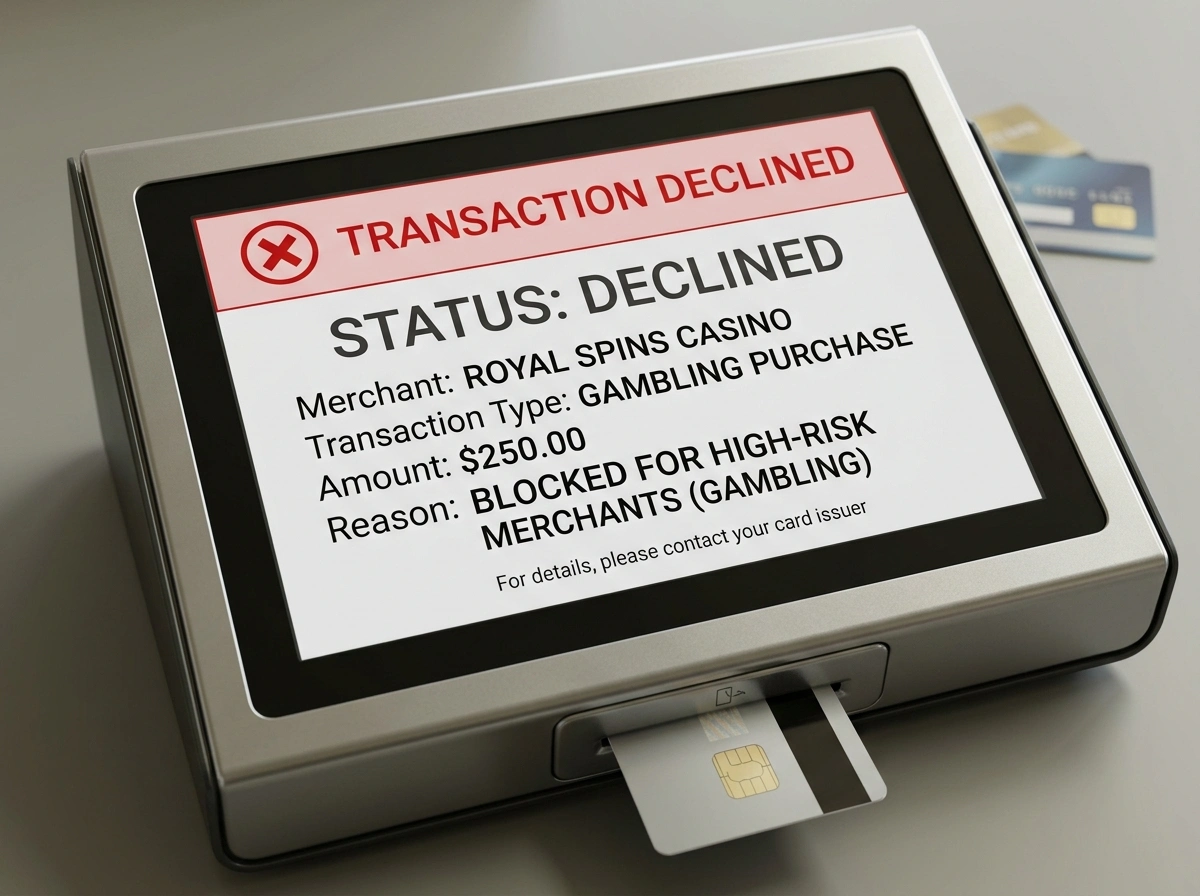
The payment monitoring layer is harder to circumvent. If the DGOJ can identify and flag payment flows to unlicensed operators, it can pressure payment processors to decline those transactions. This approach targets the financial infrastructure that offshore casinos depend on — and unlike a DNS block, a payment block can’t be bypassed by changing a browser setting. The challenge is coverage: card payments are traceable, but cryptocurrency transactions and e-wallet transfers are harder to monitor. The DGOJ has acknowledged this gap and described developing new strategies for monitoring bitcoin gambling operations.
Why Blocking Alone Cannot Eliminate the Illegal Market
The estimated volume of unregulated online gambling in Spain reached 231 million euros in 2024. That figure exists despite the DGOJ’s enforcement efforts, not in the absence of them. Enforcement reduces the illegal market — it raises the cost and complexity of operating without a licence — but it cannot eliminate it. The economics of offshore gambling mean that for every domain blocked, a mirror can be launched for a few hundred dollars. For every payment channel disrupted, an alternative emerges. The game is asymmetric: the DGOJ must succeed every time, while the operator only needs to succeed often enough to turn a profit.

Nearly half of surveyed players — 47.5% — who believe they only use legal sites have accessed non-.es domains. This awareness gap means that a significant portion of the illegal market’s volume comes not from players deliberately seeking out unlicensed casinos, but from players who don’t know the difference. Domain blocking protects this group most effectively: if the casino they stumble across is blocked, they’re unlikely to pursue alternative access methods. The scale of Spain’s illegal gambling market reflects both enforcement gaps and the fundamental challenge of controlling access to a global internet.
The DGOJ’s evolving approach — combining DNS blocking with payment monitoring, cross-platform deposit limits, and behavioural detection algorithms — represents a multi-layered strategy that acknowledges no single tool is sufficient. Enforcement isn’t a solution. It’s a constraint that, combined with a competitive regulated market and effective player education, can reduce the illegal market to a manageable size. Eliminating it entirely is a goal no jurisdiction in the world has achieved.
FAQ
How many illegal gambling sites did the DGOJ block in 2025?
The DGOJ blocked 229 portals covering 2,961 web pages in 2025. Each portal may operate multiple URLs including landing pages, promotional pages, and localised versions. The blocks are implemented at the DNS level through Spanish ISPs, which redirect requests for blocked domains to a DGOJ notice page.
Can the DGOJ track cryptocurrency payments to illegal casinos?
The DGOJ has stated it has data on credit card payments to gambling operators and is developing new strategies for monitoring bitcoin gambling operations. Credit card transactions are traceable through merchant category codes and payment processor records. Cryptocurrency transactions are harder to monitor because they bypass traditional banking infrastructure, though blockchain analysis tools are increasingly sophisticated.